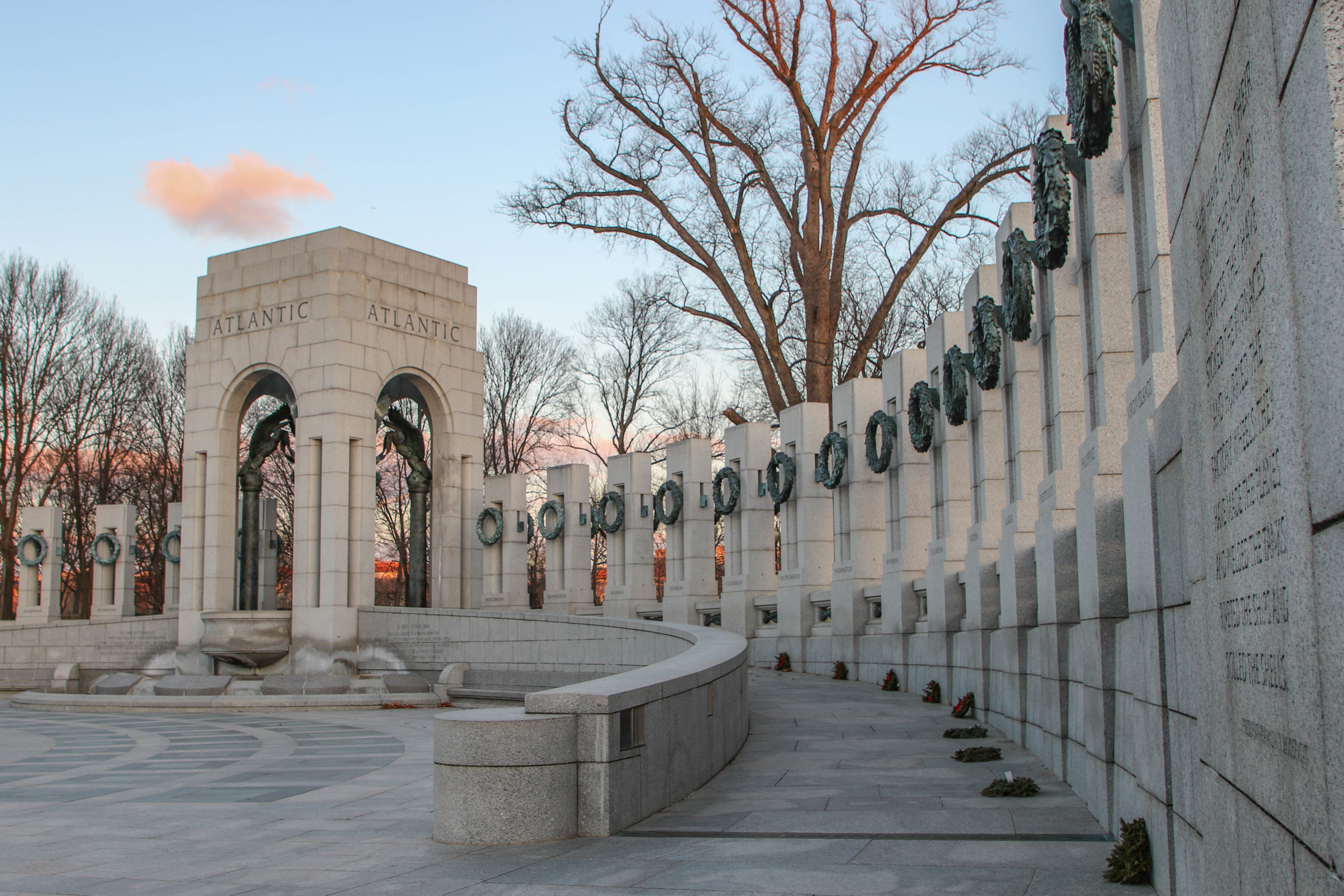
World War II Honoree
World War II Veteran
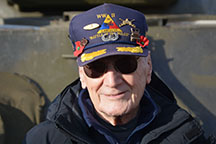
Harry F. Miller
Branch of Service
U.S. Army
Hometown
Columbus, Ohio
Honored By
Serge LeMaire
Relationship
Friend
He entered the U.S. Army on July 2, 1944 at Fort Hayes Columbus, OHIO. He trained at Fort Knox, Kentucky as a tank crewman and went overseas in October 1944. Landed at Le Havre, France. Delivered some Landing Vehicle Tracked (LVT) to the British at Antwerp, Belgium. Went to Replacement Depot 'Camp Old Gold' near Le Havre and was assigned to the 740th Tank Battalion, First Army at Neufchâteau (Belgium) in late November, 1944. On December 16, 1944 the Germans began operation Wacht am Rhine what became known as The Battle of the Bulge. The 740th Tank Battalion was directed to proceed to Sprimont (Belgium) where tanks would be issued at an Ordnance Depot in that town. However, upon arrival, the Battalion discovered that the Depot personnel had left in a hurry leaving all of their equipment and tools behind. Many worn out and battle scarred tanks and other equipment were found so work was started to piece together tanks by taking parts from one wrecked tank to use on other tanks that were in better shape. Work continued throughout the night and the following days until on December 19th, Harry and his 'C' Company were ordered to the area of Stoumont, Belgium to stop the German penetration near the Railway Station. Company 'C ' at that time had only two thrown together tanks and an M-36 Tank Destroyer but attacked as ordered with elements of the 30th Infantry Division. As the three vehicles moved forward they rounded a curve and came face to face with the lead tanks of Kampfgruppe Peiper of the 1st SS Panzer Division. As the first tank saw the approaching German Panther, it fired and destroyed the German tank. The tank then immediately tried to reload when the round stuck and was unable to fire. The tank commander told the next one in line to pass him by. As the second tank rounded the curve it fired, destroying the second German tank in line. The next vehicle used by His company was a restored M-36 Tank Destroyer which was called forward and passed the curve in the road firing and destroyed the third German tank. With this accomplished, the lead element of the attacking German column turned and retreated toward Germany. Thus, the restored tanks within their first one half hour of combat, had turned the tide of the German attack by the Battle Group Peiper of the 1st SS Panzer Division in that area. Later on, with a full compliment of armored vehicles, the Battalion pushed East to battle in Stoumont, at the Sanatorium. There were many Belgian children huddled in the basement in fear for their lives because the Germans held the upper floors. The Germans were pushed from this area and the children were liberated. He went on to cross the Siegfried Line in the Udenbreth, Losheimergraben, Herresbach region, after a long and hard fight along with the 82nd Airborne Division. His Battalion was next attached to the 8th Infantry Division and crossed the flooded Roer River at Duren and pressed on across the Cologne Plain to capture the South side of this city. His next move was to the South to the 63rd Infantry Division, in the 7th Army area to assist the division in taking again the Siegfried Line near the city of Saarbrucken on the Saar River. Moving back North to the first Army area, He crossed the Rhine River at Bonn, Germany and linked up with the 8th Infantry Division again to enter the Ruhr Pocket Battle at Siegen, near Cologne. After this battle, he was finally given a two week rest in the city of Dusseldorf. Next came the crossing of the Elbe River at Bleckede. A very heavy artillery was encountered although losses were light for the unit. On the East side of the Elbe a sharp turn to the North was made and a fast 'Blitz Krieg' was performed through Neuhaus, Ragenow, Stralendorf, to race to the Baltic Sea at Schwerin, Germany (near Wismar), which effectively blocked the Soviet Army from taking Denmark. At this point the war was declared over on May 8, 1945. Since Schwerin was to become part of the Russian Zone, the Battalion departed on June 5, 1945, to assume its Army Occupation duties within the U.S. Zone of Germany. He moved South to Kassel and remained there until July 23, 1946. Upon deactivation of the 740th Tank Battalion, He was assigned to the 39th Infantry Regiment at Bad Tolz (former SS Officers School). He was further assigned to Headquarters Company with duty in the Regimental Message Center. While at Bad Tolz, He was ordered to scout through the Alps looking for Martin Borman, Hitler’s former secretary. The 9th Infantry Division deactivated in December 1946 and He was again dispersed. He was assigned to Headquarters Troop, 2nd Constabulary Regiment at Freising, Germany, approximately 30 miles North of Munich. The U.S. Constabulary was a police unit formed to replace the equivalent of a state police. There was a Constabulary Headquarters with 3 Brigades of 3 Regiments with 3 Squadrons to cover the U.S. Zone of Germany. He guarded the U.S./U.S.S.R. Zone Borders as well as the Austro/German Border and Berlin. His job was message center chief. After several months, the Constabulary was downsized and He became the message center chief in the 42nd Constabulary Squadron at Fussen. The 42nd Squadron was later moved to Augsburg, Germany where he remained until after WWII. He continued his service in the U.S. Air Force, receiving many medals.