World War II Honoree
World War II Veteran
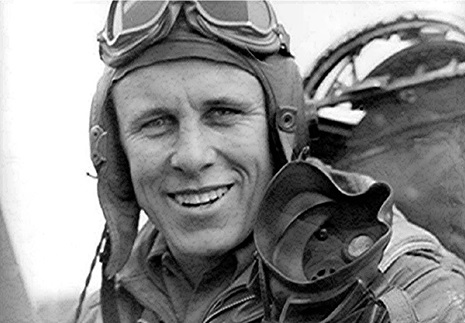
Edwin Bert “Cotty” Cottrell
Branch of Service
U.S. Army Air Force
Hometown
Slippery Rock, Pennsylvania
Honored By
Carol Cottrell Fisher & Susan Cottrell Nation
Relationship
daughters
He was 20 when he enlisted in the U. S. Army Air Forces, August 10, 1942, in Pittsburgh, Pennsylvania. Following physical conditioning in Beloit, Wisconsin, and Santa Ana, California, he began formal basic training and initial flight training at Visalia Army Airfield (AAF), Visalia, California, in the Fairchild PT-19A “Cornell”; then at Chico AAF, Chico, California, in the Vultee BT-13A “Valiant”; and finally, at Luke Field, Phoenix, Arizona, and Wendover Field, Utah, in the North American AT-6 “Texan.” By April 15, 1944, he had graduated from flight training at Luke Field, pinned on his pilot wings (1055 pilot, s. e., fighter) and been assigned to the fighter aircraft of his choice, the Republic P-47D “Thunderbolt.” That summer, he was assigned to the 9th Air Force, 48th Fighter Group, 493rd Fighter Squadron, as a replacement pilot, and in August 1944, he and other new replacement pilots of the 493rd were deployed to England aboard the Île de France, a luxury ocean liner that had been converted to a troop transport. The 493rd Fighter Squadron operated initially out of the airfield at Cambrai, France, and was housed in mostly Quonset® huts, tents and other temporary buildings. Later, the 493rd moved its operations from there to the airfield at Sint-Truiden (Saint-Trond) in what had been German-occupied Belgium. This move was to support the U.S. 9th Army’s crossing of the Rhine and open up Allied access to the German heartland to the east. Once in theater, he was given an initial operational shake-out by the older, more experienced combat pilots—flying formation and dive-bombing and strafing, all in support of the 9th Army’s ground invasion. In the first three weeks, he flew five combat missions. One of those first missions was to bomb and strafe German Tiger tanks in the forests near Koblenz on what would turn out to be the first day of the Battle of the Bulge. December 17, 1944, he said, would be a day he would always remember. That day, two squadrons of enemy Messerschmitt Bf 109 fighters attacked his flight of eight P-47s during their first bomb run. His P-47 immediately took a burst of 20mm cannon fire in the engine and began losing oil. As he quickly lost altitude, two of the attacking 109s suddenly showed up beside him, then crisscrossed behind him—the usual firing position for a shoot-down. But that didn’t happen. “They could easily have shot me down,” he said, “but they didn’t.” Instead, the German pilots escorted him back to Allied lines, flashed him the OK sign, saluted, then disappeared. Miraculously, he managed to chug-chug back to the field at Sint-Truiden just as the engine seized and he dead-stick landed at the end of the runway in a shower of sparks. He explained later that he “owed his life to that Pratt & Whitney R-2800 radial engine—2,000 horsepower, double-nine cylinders. It enabled me to return home where no other engine would.” In all, he flew a total of 65 combat missions in Europe. He was honorably discharged from the U.S. Army Air Forces as a first lieutenant, in Indiantown Gap Military Reservation, Pennsylvania, October 26, 1945. Following the war, he continued his service in the U.S. Air Force Reserve, retiring eventually as a lieutenant colonel. Battles and Campaigns: Ardennes, Rhineland, Central Europe. Decorations and Citations: European African Middle Eastern w/3 battle stars, Air Medal with 8 clusters, Unit Citations; National Order of the Legion of Honor (France, 2024).