
World War II Honoree
Civilian on the Home Front
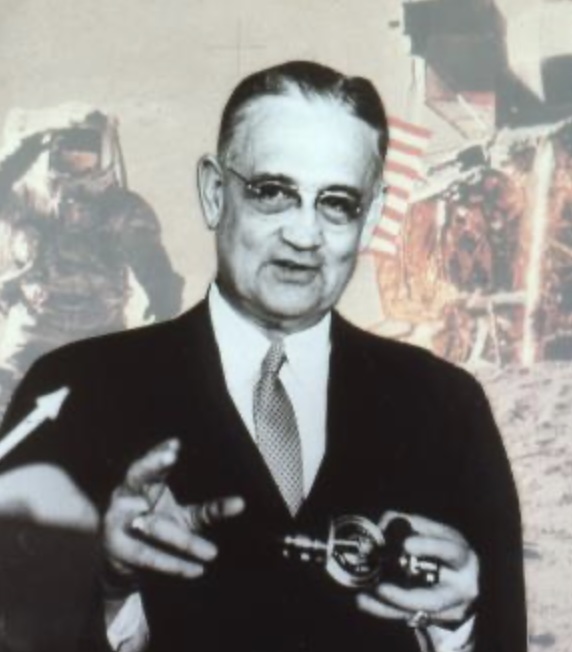
Charles Stark Draper
Hometown
Windsor, Missouri
Honored By
Ralph Bozorth
Relationship
A Grateful American
During World War II he led his students and colleagues at the MIT lab in the lab development of the Mark 14 Gun Sight, which went on to be the most popular sight used by the Allies, with more than 85,000 built and installed. At the heart of the device is the principle of gyroscopic precession—the tendency of a spinning disc or rotor mounted on a gimbal to cause the gimbal to tilt or pitch when an outside rotation is applied. The traverse gyroscope reacted to the motion of the gun being turned to the right or left, and the elevation gyroscope reacted to the barrel being raised up or down. The small rotation of the gimbals holding the spinning rotors induced by precession was translated by rods connected to the mirrors of the reflector sight, which moved the image of the reticle projected on the glass of the sight accordingly. Combined, the gyroscopes allowed the reticle image of the sight to give the gunner a simple, accurate aiming point that automatically provided a lead angle. The Mark 14 was used in combination with the Mk 51 director to remotely control quad 40-mm Bofors guns. A study analyzing antiaircraft gun performance during the war found that the 20-mm and 40-mm guns accounted for more than 60 percent of all enemy planes shot down. The remarkable Mk 14 gyroscopic gunsight enabled antiaircraft fire accuracy that contributed significantly to that success.